
Your Creative Brief Is Working Against You
The data on how the most foundational document in marketing became an obstacle to the work it was supposed to enable.

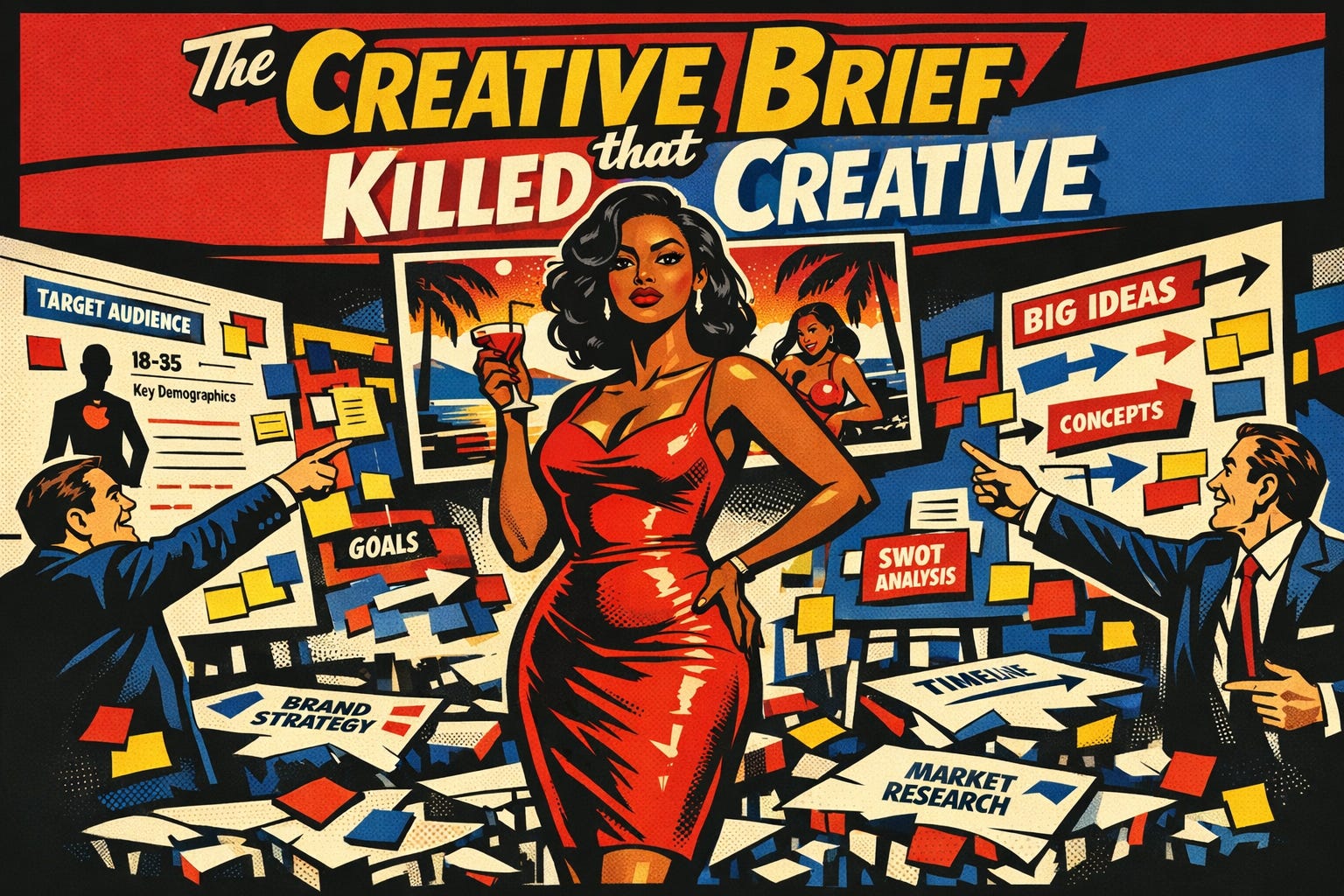
At some point in the last decade of sitting across from marketing teams, I noticed something that had always been true but had never been named clearly enough to act on. The creative brief was not a tool for solving a problem. It was a record that a problem had been acknowledged. Someone had typed into the boxes. Someone had circulated it. Everyone had nodded. The work could now begin.
Except the work it was supposed to enable, the creative work, the commercial work, was already compromised before a single concept had been sketched.
The Prior Error
Most creative briefs are built on a foundational mistake, and it happens before anyone opens the template.
The mistake is treating the document as the strategy, rather than as a downstream record of strategy that already exists. When organizations fill in the brief to produce clarity, rather than to communicate clarity they already have, the document becomes a performance. The boxes get answered. The answers resemble strategy. The process is complete. The problem has not been touched.
Albert Einstein supposedly said that if he had an hour to save the world, he would spend 55 minutes defining the problem. The brief typically spends those 55 minutes in sections labeled “brand overview” and “tone of voice.” The problem statement, where it appears at all, is usually a restatement of the objective. We want to increase awareness. We want to drive consideration. These are not problem definitions. They are wishes dressed in business language.
Systems thinking applied to a campaign starts somewhere else entirely. What is the actual behavior we want to change, in whom, and through what mechanism? What does the person currently believe, feel, or do that makes that change unlikely? What is the simplest true thing we could say that would shift that? What would be different in the world if this campaign worked?
These questions are harder than filling in boxes. They require someone to know the business from the inside, to have sat with the customer data, to understand the competitive dynamics not as bullet points but as lived friction. They require epistemic honesty about what is actually known and what is being assumed. That kind of honesty is uncomfortable inside organizations where the brief is an approval document as much as a thinking tool, and where filling it out confidently is part of the job description.
Takeaway: The brief is a downstream artifact of strategic thinking, not a producer of it. When organizations treat brief completion as equivalent to doing strategy, they manufacture a document that satisfies the process and confuses the work.
The Numbers
The gap between what brief-writers believe they are producing and what the work actually requires is not anecdotal. It has been measured.
The Better Briefs Project surveyed more than 1,700 marketers and agencies across 60 countries and found that roughly a third of all advertising budgets are wasted as a direct consequence of bad briefs. Creative agencies reported that 83% of the briefs they receive lack focus, 79% lack clarity, and 65% lack inspiration. Those are not marginal complaints. They describe a systematic upstream failure that compounds at every stage that follows.
The more revealing number is this one. 78% of marketers believe the briefs they write provide clear strategic direction. Only 5% of agencies agree.
That 73-point gap is not a communication problem. It is a perception problem, and perception problems are harder to fix because the person with the distorted view has no obvious reason to question it. A separate survey by the Association of National Advertisers found that 58% of clients believed they were doing a good job with creative briefs, while only 27% of agencies agreed, and zero percent strongly agreed. In an Ad Age survey of 1,200 agency leaders, zero respondents found the briefs they received complete and focused all the time. Zero. In a sample of 1,200.
Three in five marketers admit to using the creative process itself to clarify their strategy. That is a significant admission. It means the strategy in the brief was not a strategy. It was a placeholder. The agency was handed a map to a destination the client had not yet chosen, and the expectation was that the creative work would navigate the confusion on their behalf.

Mark Ritson, a professor of marketing and one of the industry’s most cited practitioners, known for his evidence-based approach to brand strategy and his longstanding critique of how marketing is taught and practiced, put it precisely: “90% of marketers fail to brief agencies effectively, and their failures begin with a total lack of strategy.”
There is also a political dimension that surveys mostly avoid naming. The brief exists, in part, as organizational protection. If the campaign fails, the brief is evidence that the right process was followed. The process, not the outcome, becomes the deliverable. This produces a specific kind of document: one optimized for approval rather than for use. It answers the questions that need to be answered to move forward, not the questions that would make the work good.
A third of marketers identified knowledge of writing agency briefs as a skill gap in their own business, according to Marketing Week’s 2025 Career and Salary Survey. The form is mandatory. The training is optional. This produces exactly what you would expect.
Takeaway: The brief-writing crisis is not primarily a craft problem. It is an organizational behavior problem. The document serves the people who produce it before it serves the people who have to work from it, and the data reflects that at every level of the system.
What AI Did to the Problem
Generative AI tools have now been applied to the brief. The pitch is efficiency: faster first drafts, consistent structure, reduced miscommunication. These are real benefits if the input is sound. The problem is the input was never sound to begin with, and AI does not repair that. It learns from what exists.
Consider what exists. If 83% of briefs lack focus, 79% lack clarity, and three in five contain no real strategy at all, then the corpus of brief-writing that AI models have trained on is predominantly a library of well-formatted strategic confusion. The AI has ingested thousands of documents that look like briefs, follow the structure of briefs, and use the language of briefs, while being, in the majority of cases, empty of the thing briefs are supposed to carry. That is the data warehouse. That is what gets scaled.
The output is exactly what you would expect from that input. Briefs that look exactly like briefs are supposed to look. Fluent. Competent. Fully occupied with the form of strategic thinking and largely innocent of its substance. The document reads as if someone thought carefully about the target audience, the competitive context, the single-minded proposition. The cognitive work that should have produced that content is not present, because producing a convincing document does not require doing the underlying thinking. It only requires knowing what a document that reflects that thinking looks like.
The result is not better briefs produced faster. It is the industrialization of the prior failure, with a credibility premium attached because the output came from AI. Polished incompetence at scale, and now harder to question because the machine produced it.
Ed Tsue, former chief strategy officer at Google and WPP, described modern briefs as “regurgitated objectives from whatever the client said, vague audience definitions, re-iterated objectives disguised as strategies, and deadlines.” That was before AI made the regurgitation instantaneous and gave it the aesthetic confidence of something that had been carefully considered.
Takeaway: AI brief generation does not solve the strategic deficit at the heart of bad briefs. It encodes that deficit at speed and wraps it in enough polish that the deficit becomes harder to see and harder to challenge.
The Effectiveness Consequence
This is not a process complaint. The downstream consequences are measurable.
Peter Field is a marketing effectiveness consultant who has spent decades analyzing what actually makes advertising work in commercial terms, drawing on one of the largest databases of campaign performance data in existence. His analysis of 24 years of data from the Institute of Practitioners in Advertising found that creatively awarded campaigns went from being around 12 times more efficient than non-awarded campaigns before 2008 to being essentially indistinguishable from them by 2018. Field traced the cause to a structural shift: campaigns increasingly built around short-term, tactical objectives that creativity cannot amplify. Creativity works by building memory and emotional association over time. When the brief asks for something immediate and transactional, creative quality delivers no multiplier. It is simply an expensive way to produce forgettable work.
The brief is where that mismatch is manufactured. Not in the execution. Not in the media plan. Upstream, quietly, weeks before the creative team begins.
The Value of the Right Question
I want to use an equation I have formed over the years to help guide my thinking across many strategic and business decisions. In the spirit of trying to encapsulate a great deal into something smaller and more manageable, I find that equations force honesty in a way that prose can avoid. They expose the variables, make the relationships explicit, and resist the kind of vague language that briefs tend to reward.
Value ∝ (Demand × Relevance) / Friction
You read this as: the value a campaign delivers scales with how well it addresses something the audience already cares about, multiplied by how precisely it maps to their actual situation, divided by how much effort is required to act on it. A brief built on a generic audience understanding and a vague objective bakes friction in from the first sentence. Every layer of execution that follows inherits that friction. The campaign works against itself before a frame has been shot.
The brief that fixes this is not a better-filled template. It is the output of a prior conversation in which the real commercial problem has been stated honestly, the audience has been understood specifically, and the mechanism of change has been identified rather than assumed. That conversation does not fit neatly into a form. It requires someone in the room who is willing to say what is not known, what is being guessed, and what the actual question is.
No AI tool, no template redesign, and no training on brief-writing mechanics addresses that prior failure. The fix is a commitment to honest problem definition before anything gets written down, and a willingness to sit in the discomfort of not having an answer until the right question has been asked.
Takeaway: A brief is only as good as the thinking that preceded it. The template is a vessel. If the thinking is not there before the document opens, no amount of process, polish, or AI assistance puts it there afterward.
Next week I will cover what a great brief actually looks like. The Anatomy of a Great Brief, coming next week.
STRATEX by Naz is a weekly publication on the cognitive, behavioral, and strategic forces that shape how people, organizations, and markets actually work. Subscribe if this is the kind of thinking you find useful.