
Off. Then On. Then Off Again.
The physics behind power cuts, and what they have to do with a Serbian inventor who died broke.


You are watching something on television in Addis. Mid-sentence, mid-scene, the screen goes black. The refrigerator hum disappears. The room goes very quiet. And then, sometimes in four minutes, sometimes in four hours, everything comes back as if nothing happened.
Most people in Addis have experienced this hundreds of times. Most assume it is someone’s fault. A broken wire, an engineer who missed a shift, a bad decision at Ethiopian Electric Power. Sometimes those things are true. But the more important reason, the one that explains why it can happen within minutes of apparent normalcy, is physics. Specifically, one number that the grid must hold exactly, every second of every day, without exception.
That number is 50.
Why 50?
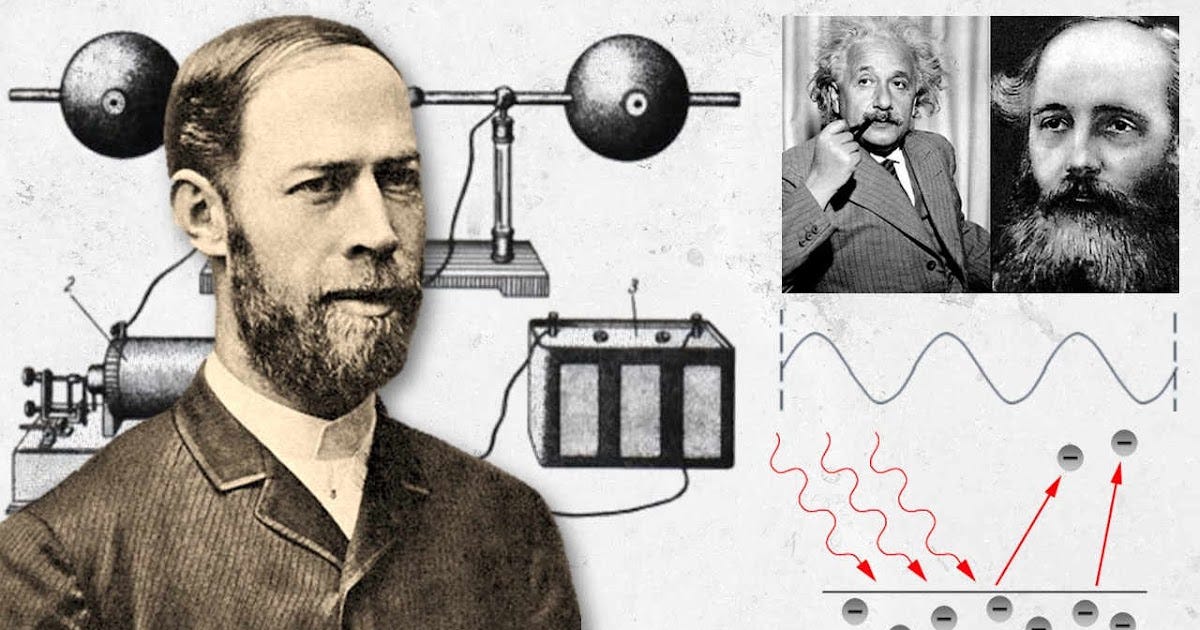
Heinrich Rudolf Hertz was a German physicist who first conclusively proved the existence of electromagnetic waves. He was 31 years old when he did it. When someone asked what practical use his discovery might have, he said: “Nothing, I guess.” He came down with a rare autoimmune disease and died in 1894, at the age of just 36. He did not live to see the unit of frequency named after him. That happened in 1930, thirty-six years after his death.
Every radio, television, phone, Wi-Fi signal, and power grid on earth now carries his name. The man who thought his work had no use whatsoever has his surname in the technical vocabulary of the modern world.
One hertz means one complete cycle per second. Fifty hertz means fifty complete cycles every second. So when we say the Ethiopian grid runs at 50 hertz, we are saying it completes 50 full cycles every second, continuously. Fifty cycles of what, though, is the question most people never ask.
Two Men, One Argument, and the Reason Your Grid Works
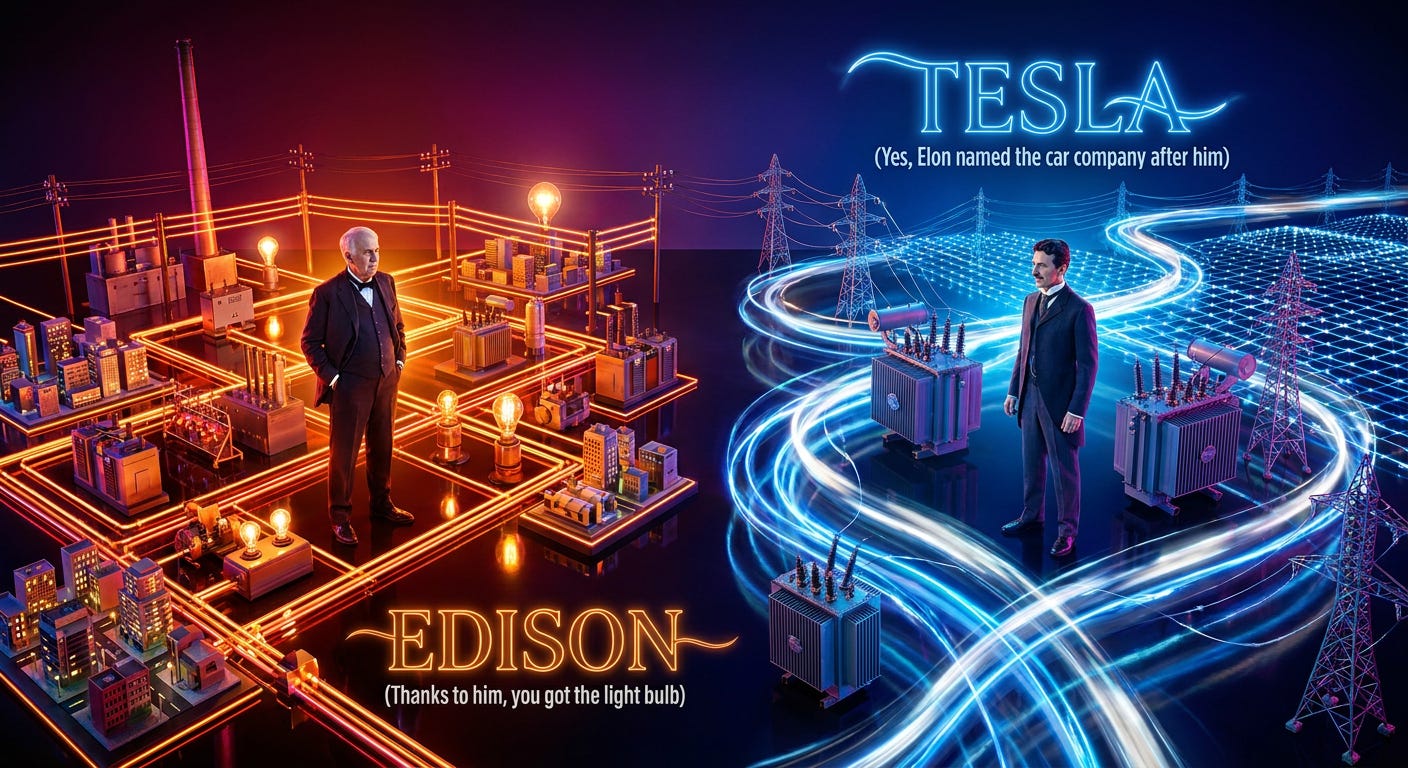
In the 1880s, two of the most brilliant minds in the history of electricity were in a bitter fight. Thomas Edison, already famous for the light bulb, was building power stations across cities to electrify the world. His system used what is called direct current. Nikola Tesla, a Serbian-American inventor who briefly worked for Edison before they parted ways badly, believed in something different. The fight between them became known as the War of the Currents.
Edison’s Direct Current
Direct current is exactly what it sounds like. Think of a river. Water flows in one direction, from the mountain to the sea, steadily, consistently. Edison’s electricity worked the same way. The current flowed in one direction from the power station to your home. It worked well over short distances. The problem was that direct current could not efficiently transmit electricity beyond about 1.5 kilometers. That meant you needed a power station roughly every kilometer and a half. In a small city neighborhood, manageable. Across a country, impossible.
Tesla’s Alternating Current
Tesla’s system used alternating current. Instead of a river, think of a rope. Tie one end to a wall and hold the other end in your hand. Shake your hand rhythmically up and down. Waves travel from your hand all the way to the wall. Your hand never moves toward the wall. The rope itself does not go anywhere. But energy does, as a wave, because each section of rope passes the motion to the next.
Alternating current works on the same principle. The energy travels as a wave through the wire. How many times per second you shake your hand up and down is the frequency. Shake once per second and you have 1 hertz. Shake fifty times per second and you have 50 hertz. That is exactly what the Ethiopian grid does, fifty back-and-forth waves traveling through every wire in your home, every single second the power is on.
To understand why Tesla won the argument, you first need to understand something nobody explains clearly: what voltage actually is.
Think of voltage as urgency. When electricity is at high voltage, it is under enormous pressure, desperate to move, like a crowd packed tightly at an exit. Low voltage is that same crowd spread across a wide open space, drifting slowly toward the door. The voltage is the force pushing the electricity through the wire. Higher voltage, more force, more urgency.
Every wire in the world has some resistance. It pushes back slightly against the electricity moving through it, converting a fraction of that energy into heat. That heat is wasted energy that never reaches its destination. The critical detail is that the heat lost depends not on how high the voltage is, but on how much current is actually flowing through the wire. Reduce the current and you dramatically reduce the waste.
This creates an elegant solution for long distances. If you can transmit the same amount of energy using high voltage and low current rather than low voltage and high current, you lose far less along the way. Think of it like carrying money. You need to deliver 10,000 birr across the city. You could carry it as 10,000 one-birr coins, heavy, scattered, easy to drop along the way. Or you could carry it as ten 1,000-birr notes, same value, far less lost in transit. High voltage is the large denomination note. You move the same energy with far less spillage on the journey.
The problem is that the extremely high voltage needed for long-distance travel would destroy every appliance in your home. It is like arriving at a small kiosk with a 1,000 birr note to buy a single piece of gum. The money is real. The value is there. But the transaction cannot happen because the denominations do not match. The transformer is the suk guy on the corner who has change. He takes your 1,000 birr and gives you back what you can actually spend. Without him, you are standing at the kiosk unable to buy your gum, and your television unable to receive its power, both transactions stuck because nobody has change.
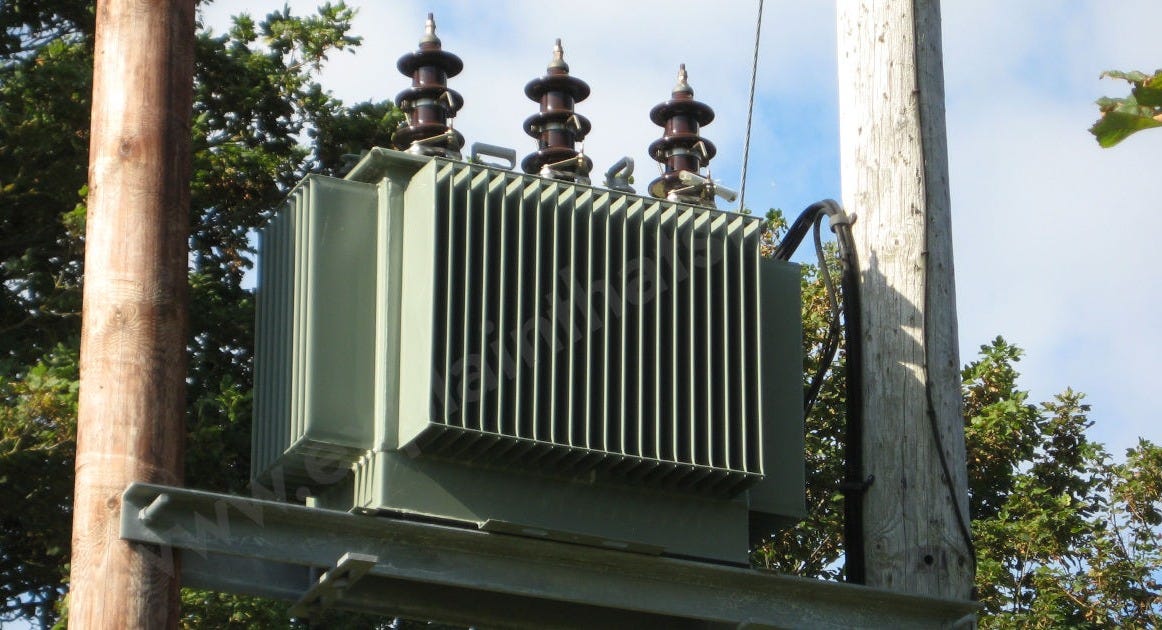
Think of a transformer as a silent middleman. Electricity comes in one side, and through nothing more than an invisible magnetic handshake through a piece of iron, a different amount of electricity comes out the other side. No fluid. No moving parts. No burning anything. Just two coils of wire that never touch each other, passing energy between them through a field you cannot see.
The number of loops in each coil is the only thing that determines whether the voltage goes up or down on the other side. More loops out than in, and the voltage rises. Fewer loops out than in, and it drops. That is the entire mechanism. Two coils and a piece of iron, and the grid can take electricity from a dam hundreds of kilometers away, shrink it down to something your television can handle, and do it billions of times a day without a single moving part wearing out.
But this only works if that magnetic field keeps changing. The field needs to pulse continuously to keep inducing current in the second coil. Tesla’s alternating current, reversing fifty times a second, does exactly that. It keeps the field alive and moving. Edison’s direct current flows in one steady direction, creating a magnetic field that sits static and induces nothing. The transformer goes quiet. No conversion happens.
This was the decisive difference. Tesla’s system could boost electricity to high voltage at the dam, transmit it hundreds of kilometers with minimal loss, and step it back down at neighborhood substations until it arrived at your television at exactly the level it was designed to receive. Edison’s system had no equivalent. His customers had to live close to a power station or go without.
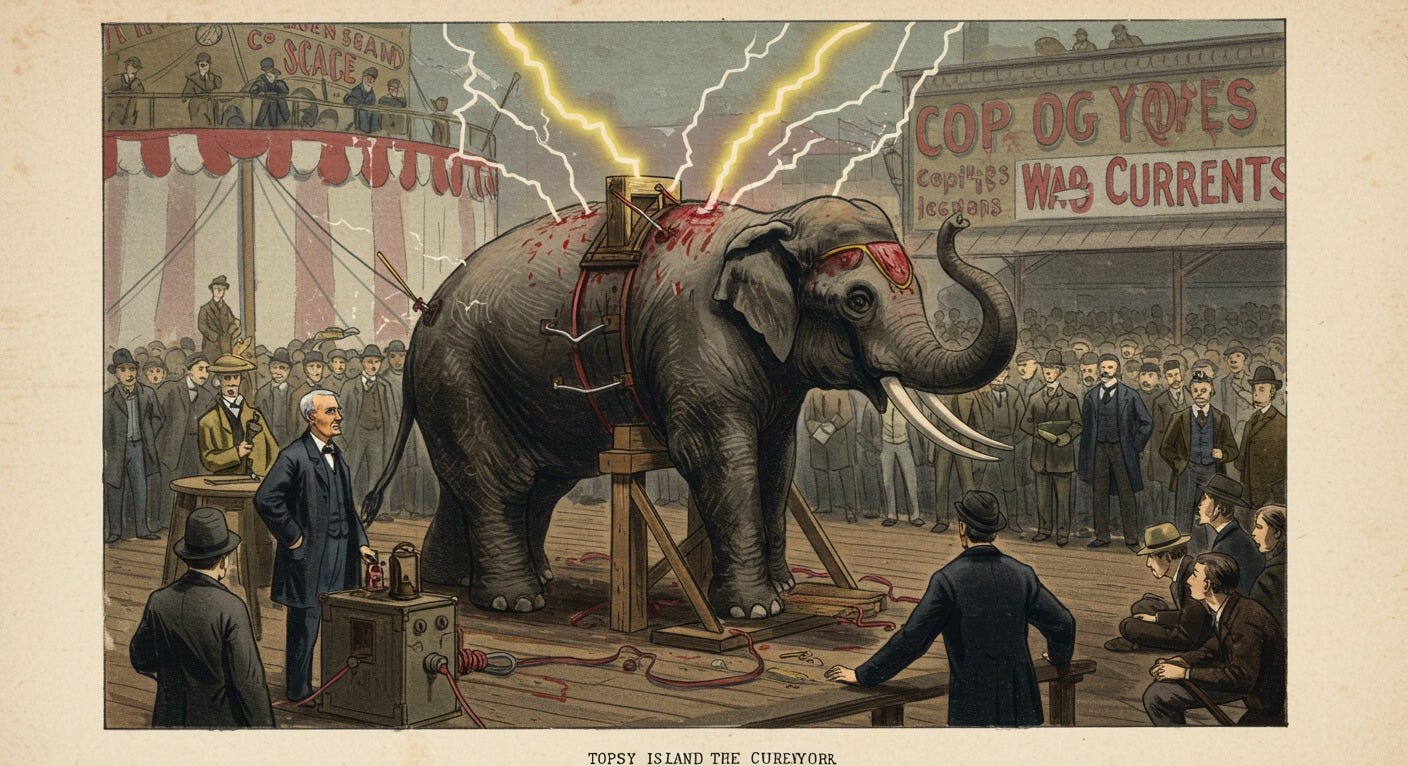
To protect his financial interests, Edison launched a smear campaign against alternating current, spreading misinformation and even staging public electrocutions of an elephant using AC to prove it was dangerous. He lost the argument anyway. Every grid on earth runs on Tesla’s system. Every time you plug something in, you are using the technology of a man who once had his ideas attacked by one of history’s most famous inventors. The same Tesla is the person the famous car Tesla is named after.
The One Rule the Grid Cannot Break
Here is the law at the center of everything:
Power being generated right now = Power being consumed right now + Power lost in the wires
Not approximately. Not on average across the day. Exactly, at every moment.
No other commodity works this way. If a bakery makes more bread than it sells today, the shelf holds it until tomorrow. If a bottling plant produces more water than the market needs this week, the warehouse takes the surplus. These industries have buffers. Time absorbs their mismatches. The grid has no such buffer. Electricity cannot be meaningfully stored at any scale that matters. You generate it and someone consumes it at the same instant, or the equation breaks.
When generation falls below consumption, the shortfall goes somewhere. It goes into frequency. The grid begins to slow down. And the speed at which it slows depends on one variable that is particularly important in Ethiopia.

What Inertia Has to Do With Running
To illustrate what happens inside a turbine when the water drops, I am going to use Yomif Kejelcha. If you do not know this man, he is quite simply the most exceptional running machine we have produced as a nation. In April he ran his debut marathon in London in 1:59:41, becoming the second person in history to officially break the two-hour barrier. There is an upcoming article on how the geography of Ethiopia's highlands shapes running performance at this level. But for now, imagine Yomif is running toward your place bringing you pizza, faster than a Dodai electric bike.
Now imagine he gets a call telling him to stop. He cannot. Not instantly. His body’s momentum carries him forward for several more strides even after the decision is made. That resistance to sudden change in motion is what physicists call inertia. A large mass moving fast has a lot of it. The heavier and faster the object, the longer it takes to slow down.
A massive hydroelectric turbine works exactly the same way. It is essentially a very heavy piece of metal spinning at high speed inside a generator. When the water feeding it suddenly drops, the turbine does not stop immediately. It keeps spinning on stored momentum for several seconds. Those seconds are what grid operators need to respond before frequency falls too far.
The equation that governs how quickly frequency drops when generation falls looks like this, in plain English:
Rate at which frequency changes = (Power generated minus Power consumed) divided by (2 times the Inertia times the Total Capacity)
The key variable to hold onto is the inertia piece. The larger it is, the more time the system buys itself when generation drops suddenly. Which brings us to why Ethiopia’s grid faces particular pressure during certain months of the year.
When the Water Is Low
As of April 2026, Ethiopia officially crossed a milestone that deserves recognition: national power generation capacity reached 10,000 megawatts, more than double what it was in 2018. The primary driver was the Grand Ethiopian Renaissance Dam, inaugurated in September 2025, now fully operational at its designed capacity of 5,150 megawatts. Gibe III contributes another 1,870 megawatts. Wind and geothermal fill in the remainder. The grid runs almost entirely on renewable energy, which by global standards is remarkable.
And yet the lights still go off.
The reason is not that Ethiopia has failed to build. It is that the grid draws 94% of its power from one source, water, and water is seasonal. In the dry months, roughly January through May before the main rains return, reservoir levels fall as rivers run lower. Turbines that normally spin at full power now spin at reduced capacity. Two things happen simultaneously: the amount of electricity being generated drops, and the inertia in the system decreases as the turbines slow. When the power being generated falls below the power being consumed, frequency drops faster, leaving less time to respond.
Hydroelectric turbines carry less inertia than heavy thermal generators running on coal or gas. They are more like a bicycle than a freight train. Cut the power to a freight train mid-journey and it rolls on for kilometers. Cut the power to a bicycle and it nearly stops in the next few meters.
When that gap opens and the grid cannot close it fast enough, operators face a choice. Think of a generator at a wedding that is overloaded. You can disconnect a few speaker stacks and some lights now, in a controlled way, keeping the main hall running. Or you can keep everything connected until the generator burns out completely and the entire wedding goes dark with no timeline for recovery. Load shedding is the first choice. Your neighborhood gets disconnected not because it failed, but because it was chosen to absorb the problem so the rest of the grid survives.
Takeaway: load shedding in the dry months is the grid rationing a real shortage. Not a malfunction. A managed response to a mathematical problem that has no elegant solution until more generation capacity, and crucially a more diverse mix of it, comes online.
What About When It Rains?
This is one of the most common questions people ask. Dry season, you expect cuts. But sometimes the lights go off in the middle of a heavy July downpour, and nobody explains why.
There are two completely different reasons the power goes off, and most people never learn they are different things.
The first is what we have been discussing: the grid cannot generate enough power to meet demand, so it sheds load in rotation. This is systematic, often scheduled, and happens most in the dry season.
The second has nothing to do with generation. It is physical damage to the lines and equipment carrying electricity from where it is made to where you use it. During heavy rains, lightning strikes hit transmission lines and trip the circuit breakers protecting them. Those breakers are designed to open automatically the moment something dangerous happens, the same way a fuse in your home blows to protect your appliances. A lightning bolt lands, the breaker opens, your section of the grid goes dark. Heavy rain causes short circuits on overhead lines where insulation has worn. Flooding damages the transformer boxes you see on street corners. Waterlogged soil shifts and brings down poles.
These are not load shedding. They are fault outages. Same symptom, completely different cause. Load shedding is planned because it follows a generation deficit operators know about in advance. Fault outages are random because nobody knows where lightning will strike tonight.
Both look identical from your couch. Screen goes black. No explanation arrives. One is the grid making a calculated decision to protect itself. The other is the grid being injured by weather.
Takeaway: dry season cuts are mostly load shedding, the grid managing shortage. Rainy season cuts are mostly faults, the grid absorbing physical damage. Knowing which one you are dealing with is the first step toward understanding how long the wait is likely to be.
The Demand Side
There is one more force making all of this harder. Electricity access in Ethiopia has grown from 44% to 54% of the population in recent years, and demand is growing at an estimated 20 to 30% annually, driven by industrial parks, urbanization, and ongoing rural electrification. Every new building connected to the grid, every factory coming online, every household gaining access for the first time adds to the consumption side of the equation. When supply cannot keep pace with that rate, the imbalance becomes structural rather than seasonal.
Imagine the grid as a bathtub. The tap is generation. The drain is demand. The water level is frequency, and the goal is to keep it exactly at the 50 hertz line. When the drain grows faster than you can open the tap, the level falls. Load shedding is temporarily blocking some of the drain holes. Not elegant, but it keeps the bathtub from emptying completely until you can install a bigger tap.
The ambition here is not small. Ethiopia is targeting 19,900 megawatts of installed capacity by 2030. The Koysha hydroelectric project, on the Omo River in southern Ethiopia, adds another 2,160 megawatts and is slated for commissioning later this year. The longer-term push is to diversify aggressively beyond hydropower into utility-scale solar and geothermal, which would reduce the seasonal vulnerability that makes dry months so difficult. During peak generation, Ethiopia already exports electricity to Kenya, Sudan, Djibouti, and Tanzania, turning a domestic infrastructure asset into a regional one. The goal is to close the gap between that surplus and the dry season deficit until load shedding is the exception rather than the rhythm.
The Civilizational Problem, and What Comes Next
This is where the story stops being about Ethiopia and starts being about the world.
Most of society’s critical infrastructure, power grids, water systems, transportation networks, was designed for a pace of growth that no longer exists. The systems were engineered when cities grew slowly, when demand was predictable, when the gap between building new capacity and needing it could be measured in decades. That gap has collapsed. Urbanization, industrialization, and electrification are all accelerating simultaneously, and the infrastructure managing them is still largely operated the way it was fifty years ago: human operators watching dials, making decisions based on what they can see, reacting after the frequency has already moved.
A new category of technology is emerging to address exactly this. Physical AI refers to artificial intelligence applied not to language or images but to the physical world, to the real-time behavior of machines, systems, and infrastructure. In the context of power grids, this means systems that can sense frequency fluctuations across thousands of nodes simultaneously, analyze the variables driving those fluctuations faster than any human operator can, and use domain-specific machine learning to optimize load, generation, and storage decisions in real time, before the bathtub starts to drain rather than after.
The operators watching frequency at a national load dispatch center are doing a genuinely difficult job with tools that were not built for the complexity they now face. Physical AI does not replace that judgment. It gives it a nervous system proportional to the problem.
For many countries, where generation capacity is growing fast, but demand is growing faster, and where the grid is running close to its physical limits for months every year, this is not a futuristic consideration. It is an immediate one. The math is the same math Hertz named, Tesla built, and every grid on earth runs on today. What is changing is who, or what, is doing the solving.
STRATEX by Naz is a curious place about things we all encounter every day but never stop to ask about. Subscribe below: