
Cheap for Who?
AI filmmaking tools help studios reduce costs. For an individual creator, the same tools create costs that did not previously exist. The industry only discusses the first.

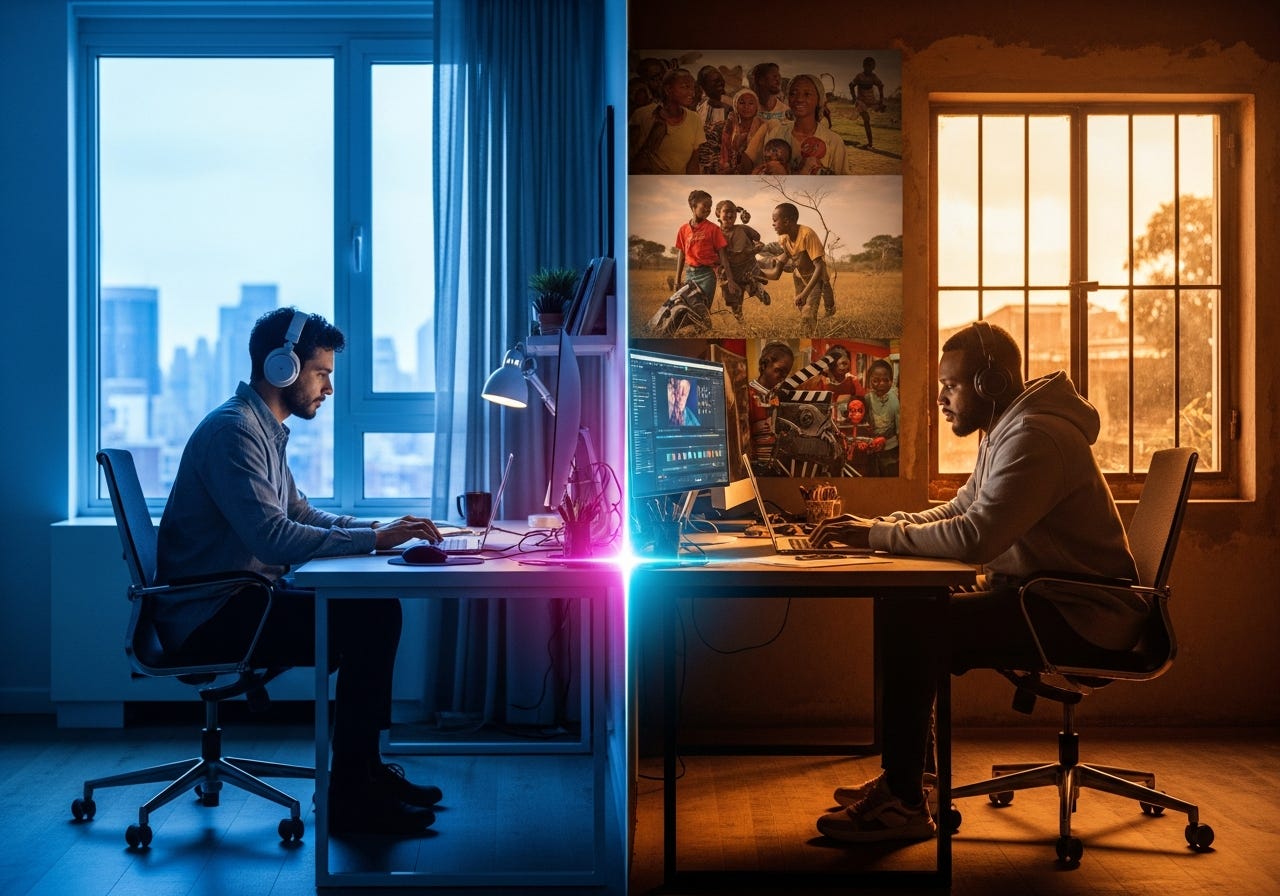
Somewhere in Manhattan, a Jason is doing what he has done every weekend for three years. He works in post-production during the day, knows his way around creative tools, and has been quietly developing a feature film script in the hours the day job does not claim. When the articles started appearing about fully AI-generated films being made for a few hundred dollars, he felt something open up. He subscribed to Runway and ElevenLabs the same week.
Across the Atlantic in Nairobi, a Kamau has a story he has needed to tell for just as long. He grew up watching his older brother’s hard drive collection, everything from early Kibera street documentaries to Nollywood to whatever film had been compressed small enough to transfer over a USB cable. A three-generation family saga set between the Rift Valley and the diaspora. He read the same articles Jason read. He felt the same thing open up.
They both started building around the same time. They both paid the same monthly subscription fees. Six months later, they were in completely different situations, and not for the reasons the "AI has democratized filmmaking" promise had led either of them to expect.
That story is partly fabricated. But the gap between Jason and Kamau is entirely real, and it is the gap the industry does not discuss. Read on.
Anyone Can. Almost Anyone.
When someone says an AI film was made for a few hundred dollars, they are describing something real about a specific project under specific conditions. A 17-minute short called “Kira” that circulated in 2024 required over 600 individual prompts to reach its final cut, with a generation-to-final ratio running 5:1 or higher, sometimes reaching 10:1 for shots requiring precise continuity. That is 17 minutes of output, produced by a solo creator in optimal conditions with a refined workflow.
The cost benchmark most often cited for a project of that length runs between $200 and $800. That number is honest for what it describes. It is not honest for what people hear when they read it, which is: anyone can make a film now.
A 90-minute feature is not six times a 15-minute short. The narrative complexity grows faster than the runtime. Character continuity across hundreds of AI-generated scenes is exponentially harder to maintain than across traditionally filmed scenes where the actor, location, and lighting remain physically constant. Every inconsistency discovered in editing sends the creator back to generation. Every clip that does not make the cut is a charge that has already cleared.
Subscription and token-based pricing behaves very differently at scale when there is no team, no shared infrastructure, and no slate of projects to distribute the cost across. That is the part the benchmark does not show.
The Studio and the Individual Are Not Solving the Same Problem
A studio adopting AI tools is replacing costs it already carries. A visual effects team, a voice cast, a post-production pipeline. Those are existing line items. When AI compresses them, the studio captures a saving against a baseline that was already funded. The math works because the studio was already spending.
An individual creator starting from scratch is not replacing anything. The subscription fees, the generation credits, the voice synthesis costs, the upscaling tools are all additive. Every dollar spent on the AI stack is a dollar the creator did not previously need to spend, because the alternative was not a $200,000 Hollywood production. It was a modest local production made with available talent, available equipment, and costs that stayed inside the local economy.
The comparison that travels in media is Hollywood against AI. The comparison that matters is: individual creator with local tools against individual creator locked into a subscription stack priced in US dollars, owned entirely by a small number of companies in the Global North, and designed for a market that is not theirs.
The word for that is dependency, not democratization.
The Subscription Clock Does Not Stop
Runway’s Unlimited plan, which provides the generation volume a feature-length project actually requires, costs $76 per month. ElevenLabs’ Pro plan, necessary for anything approaching serious voice work, runs $82.50 per month. Those two tools alone total $158.50 every month. Not per project. Per month. Whether production is active or not. Whether the creator generated anything that week or was rewriting the script, the billing cycle does not pause.
A creator producing a feature over eight months pays eight months of subscription fees before a single overage credit is purchased, before upscaling costs, before any additional tool in the stack. The cost of access is the cost of maintaining access.
The yield problem sits on top of that. To produce 90 minutes of usable footage, a working AI filmmaker generates somewhere between 40 and 50 hours of raw material. Think of it like a printing press that charges per sheet, including every sheet that comes out smeared. The yield formula is:
Y = T(output) ÷ T(generated)
Where Y is your yield rate, T_output is final footage in minutes, and T_generated is total compute time in minutes. At 40 hours generated for 90 minutes of usable output: Y = 90 / 2,400 = 0.0375. You read this as: 3.75 percent of what you pay to generate ends up in the film. The rest is the process of making something good. It is not waste. It is craft. But it is craft that bills per attempt.
The total cost of that iteration compounds across each processing layer. Maintaining a character’s face consistently across 90 minutes requires generating a base clip, running it through a face-consistency tool, then upscaling to final resolution. The same five-second clip is billed three times. Define the total iteration cost T:
T = C × (1/Y) × N
Where C is cost per second of generation, Y is yield rate, and N is processing passes per clip. At a yield of 3.75 percent across three passes, you are paying for the equivalent of each output second roughly 80 times before it reaches your timeline.
Takeaway: When a studio adopts AI tools, the savings are real because they replace existing costs across a shared infrastructure. When an individual creator adopts the same tools, the costs are also real, but they are not replacing anything. They are being added. The $200 short film and the $158 monthly subscription are both true. They describe different people in different situations, and the industry celebrates the first number while quietly omitting the second.
There Is Also Only So Much of the Day
What the cost conversation skips entirely is time. Generation is not instantaneous. A single five-second clip on a professional platform can take several minutes to render, depending on queue load, resolution settings, and model complexity. An individual filmmaker is not just paying per generation. They are waiting per generation.
Map that against a realistic working day. Assume six hours of active production time, which is generous for someone balancing this against any other obligation. Factor in prompt crafting, evaluation, iteration decisions, assembly, and the face-consistency and upscaling passes that quality requires. The number of generation cycles a single person can realistically complete in a day has a hard ceiling. Call it H, the daily productive generation hours available to one person:
H = T_day - (T_prompt + T_evaluate + T_assemble)
Where T_day is total available hours, and the subtracted terms are time spent on everything adjacent to generation itself. At six hours available, with conservative estimates for each adjacent task, the time actually spent waiting on and evaluating generations might compress to three or four hours of real output. Spread across a 90-minute feature at a 3.75 percent yield rate, the timeline to completion for a single individual working alone is not weeks. It stretches into months, during every one of which the subscription clock is running.
Jason, who works in post-production and has built-in intuitions for this workflow, can compress some of that time. Kamau, who is learning the tools while building with them, cannot. The learning curve does not pause billing either.
Production hours and subscription fees together create a ceiling that the “$200 film” framing never acknowledges. The individual AI filmmaker is not just underfunded relative to a studio. They are time-constrained in a way that no subscription pricing model accounts for.
The Geography of the Same Dollar
Jason and Kamau pay the same monthly fees. They do not live in the same economy.
For Jason in Manhattan, $158.50 per month in subscriptions is a real cost but an absorbable one, comparable to a gym membership and a streaming service combined. If the film does not earn anything, which is the most likely outcome for any independent film, the financial exposure is meaningful but survivable.
For Kamau in Nairobi, the same $158.50 represents a substantially larger fraction of monthly income. The fee does not adjust for where you live. It does not adjust for what your local currency does relative to the dollar. It does not adjust for whether you are a creative professional in a high-income market or a filmmaker in a developing economy trying to build something from nothing.
Beyond pricing, many major AI platforms accept credit cards and PayPal. In large parts of the Global South, mobile money is the primary financial infrastructure. This is a real constraint today, though one that payment technology may eventually address. What it will not address on its own is the more fundamental issue: the same flat fee extracts proportionally more from someone earning less, and that asymmetry is baked into the model.
Across 28 African countries, average credit card penetration sits at under 4 percent of the population. Across Southeast Asia, Latin America, and South Asia, the picture varies but the pattern is consistent: the financial infrastructure the platforms are built on is not the financial infrastructure most of the world uses. The tools travel. The pricing assumptions travel with them unchanged.
The Jobs That Disappeared Before the Tools Arrived
There is a second dimension to this that the cost conversation rarely enters. AI filmmaking does not just change what individual creators pay. It changes what the people around those creators were previously paid.
A local film production in Lagos, Nairobi, Jakarta, or Bogotá employs people. Camera operators, sound recordists, gaffers, makeup artists, location scouts, drivers, caterers. Most of those roles are filled locally, paid in local currency, and the money circulates inside the local economy. A production company in any of these cities running a modest shoot is not just making a film. It is distributing income across a supply chain.
An individual creator using AI tools in the same cities is not. The money goes to subscription fees and compute costs that flow directly to a small number of companies headquartered in San Francisco. The local supply chain does not exist. The economic footprint of the production is a credit card transaction, not a payroll.
For the individual creator, this can feel like freedom. No crew to manage, no logistics to coordinate. For the broader creative economy in that city, the cumulative effect of many creators making the same choice is a contraction of the local film labor market at exactly the moment when AI tools are making it easier for the work to be done without hiring anyone locally at all.
The studios adopting AI in Hollywood are having a version of this debate loudly, with unions and contracts and public disagreement. The equivalent conversation in the Global South is not happening with the same visibility, partly because the labor protections are thinner and partly because the tools arrived framed as an opportunity rather than a disruption.
Takeaway: AI filmmaking reduces the cost of production in absolute dollar terms. It also redirects spending from local labor markets to global platform subscriptions, concentrates the economic benefit of that redirection in the countries where the platforms are built, and does this at scale in exactly the markets where film labor was one of the more accessible entry points into the creative economy. The individual creator gains a tool. The community around that creator loses a set of jobs. The net effect depends entirely on which of those two things you are measuring.
A Mirage Is Still a Mirage Even When the Water Looks Real
Most AI films, like most independent films of any kind, will never earn a dollar. This is not a pessimistic observation. It is the base rate of independent filmmaking, documented across decades of data. The difference is that a traditional independent film in the Global South might be made for a cost that is proportionate to local conditions, using local resources, with the financial risk spread across a small team that shares both the effort and the exposure.
An AI feature built on a subscription stack denominated in US dollars carries a fixed monthly cost that runs regardless of progress, requires a financial instrument that a significant portion of the world’s creators do not hold, and will in most cases produce something that earns nothing, while the platforms that provided the tools collect their fees every 30 days without exception.
Jason will absorb his loss and move on. He has a day job and a financial cushion. Kamau’s situation depends on numbers that the platform’s pricing page was not designed to account for. The tools are the same. The risk is not.
The AI filmmaking revolution is real. The technology is genuinely remarkable. And it is, right now, primarily a wealth transfer from aspiring individual creators in markets the platforms were not designed for, toward the balance sheets of a small number of companies in one corner of the world, dressed up in the language of access and democratization.
The gate is not gone. It has been repriced, re-denominated, and moved to the billing page. For Jason, it is lower than it used to be. For Kamau, measured honestly against his income and his options, it may not be lower at all.
Appendix: What a 15-Minute AI Short Actually Costs in 2026
Two scenarios. Same tools. Same workflow. The only difference is whether everything goes right.
A 15-minute narrative short requires roughly 120 to 200 individual shots, each running 5 to 10 seconds. At current platform rates, here is what the tool stack costs under two conditions: the best case, where every generation is usable, and the base case, which reflects how production actually runs.
Every figure below is drawn from current published pricing as of early 2026. Prices change. Verify before you subscribe.
The Tool Stack
Video generation — Runway Pro at $28/month. Covers Gen-4 access, 4K export, and enough credits for serious short-form work without hitting the Unlimited tier.
Image generation for storyboard frames and shot references — Midjourney Standard at $30/month. Unlimited Relax mode for reference images, Fast mode for time-sensitive generations.
Voice and dialogue — ElevenLabs Creator at $22/month. Sufficient character limit for a 15-minute script, roughly 15,000 to 20,000 words of total audio.
Music and score — Suno Pro at $10/month. Commercial rights included, enough credits for a full original score across a 15-minute runtime.
Editing and assembly — DaVinci Resolve. Free tier is sufficient for a solo creator at this scale.
Monthly subscription total: $90/month
Scenario One: The Best Case
Every generation is usable. No face drift. No continuity breaks. No dialogue retakes. You generate exactly what you need, once, and it cuts together cleanly. This does not happen in practice but it is the number that circulates in articles.
One month of subscriptions: $90 Additional credit top-ups: $0 Total: $90
This is the “$200 film” scenario, adjusted for a lean stack. It assumes a creator who is already skilled with every tool, has a locked script, needs no iteration, and works fast enough to complete the project within a single billing cycle.
Scenario Two: The Base Case
A realistic production. Some shots require two or three generation attempts. Character face consistency fails on roughly one in five clips and needs a corrective pass. Two or three voice lines per scene get regenerated for performance reasons. The project takes eight weeks rather than four.
Two months of subscriptions: $180 Additional Runway credit top-ups for overflow generation: $40 to $60 ElevenLabs overage for voice retakes beyond monthly limit: $20 to $30 Upscaling tool for final render pass: $15 to $25 one-time
Total: $255 to $295
This is the realistic floor for a solo creator who knows what they are doing and is making something they would not be embarrassed to show.
What Neither Scenario Includes
Neither figure accounts for the time cost of generation queues, which can run several minutes per clip during peak hours. Neither accounts for the learning curve of a creator using these tools for the first time, which adds weeks to the production timeline and weeks of subscription fees. Neither accounts for sound design beyond music, or for distribution costs once the film exists.
For Jason in Manhattan, the base case at $295 is a considered creative investment.
For Kamau in Nairobi, the same $295 represents a proportionally larger commitment, paid in US dollars, through financial infrastructure he may not hold directly, for a film that, statistically, will earn nothing.
Bonus: Imagine What a Full Feature Would Cost
A 90-minute feature is not six times a 15-minute short. The math does not scale linearly because the problems compound. Character consistency across 540 scenes is exponentially harder than across 60. The script is longer, the voice work is heavier, and the production timeline stretches across months, not weeks, with the subscription clock running through all of it.
Using the same tool stack, the same yield assumptions from the base case, and a realistic production window of six to eight months:
Monthly subscriptions across eight months: $720 Credit overages across video, voice, and image generation: $400 to $800 Upscaling and post-production passes:
$100 to $200 Total: $1,220 to $1,720
That is the number if you are skilled, disciplined, and things go reasonably well.
It is not $200. It is not the promise. And it arrives as a personal bill, paid monthly in US dollars, for a film that the vast majority of independent releases will never recoup. The platforms collect their fees either way.
For Jason, that number is painful but survivable. For Kamau, it is a different calculation entirely, and no amount of democratization language changes what it looks like on a bank statement.
STRATEX by Naz examines the behavioral, cognitive, and forces shaping how people work, create, and decide. If this piece reframed a number you had accepted, the subscribe button is below.