
Built to Fade
Every company is born with a biological clock.

Two words appear throughout this piece that are worth settling before we begin.
Superlinear means the output grows faster than the input. Double the size of something and you get back more than double the value. Think of a rumor: tell it to two people and they each tell two more. The spread doesn’t add, it multiplies. Each new person carries the whole network forward.
Sublinear means the opposite. Double the input and the output grows, but slower than expected. Sunscreen works this way. SPF 15 blocks about 93% of UV rays. SPF 30 blocks 97%. SPF 50 blocks 98%. You keep doubling the number on the bottle and the protection barely moves. The input scales, the output doesn't keep up.
On June 28, 2024, Nike’s stock fell 20% in a single trading session. That erased roughly $28 billion in market capitalization, making it the worst single-day performance in the company’s history since its IPO in 1980. The proximate cause was a quarterly earnings report showing revenues down, margins compressing, and full-year guidance withdrawn entirely. Analysts blamed the CEO. Sneakerheads blamed the Air Force 1 saturation. Supply chain people blamed the inventory mess. None of them were wrong about any of it.
But they were describing symptoms.
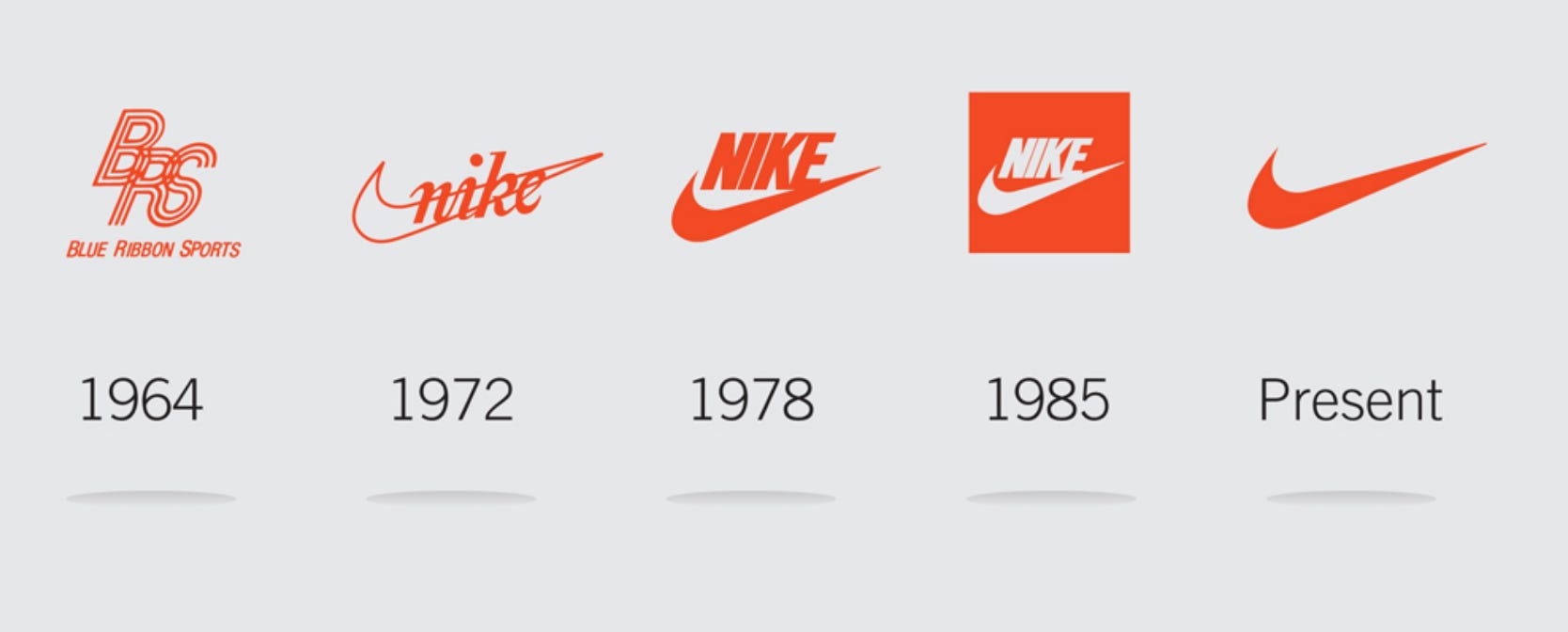
Nike was founded in January 1964, operating out of the trunk of a car under the name Blue Ribbon Sports before becoming the brand the world knows. Sixty-two years old in 2026, it still commands roughly 16% of the global sportswear market. It is not dying by the usual definition. And yet something in it is aging in a way that revenue charts capture only indirectly. To understand what that something is, you have to leave the earnings reports behind and go to a physics lab in Santa Fe, New Mexico.

Geoffrey West spent the early part of his career as a theoretical physicist at Los Alamos, working on problems in particle physics that had nothing to do with business. In the 1990s, his attention shifted to a different kind of scaling problem: how living systems grow. Working with macroecologist James Brown, West helped formalize what biologists had observed for decades without fully explaining. The rule is called Kleiber’s Law, and it goes like this: metabolic rate scales with body mass to the three-quarters power.
What that means in plain terms is that a whale, roughly a million times heavier than a mouse, doesn’t need a million times more calories to stay alive. It needs about 31,623 times more. Each time body mass doubles, metabolic needs increase by only about 75%. Bigger animals are more efficient, but efficient in a very specific way: they live slower. A shrew’s heart beats 1,000 times per minute. A human heart beats around 70. An elephant’s beats 28. Every mammal, regardless of size, gets roughly the same number of heartbeats per lifetime.
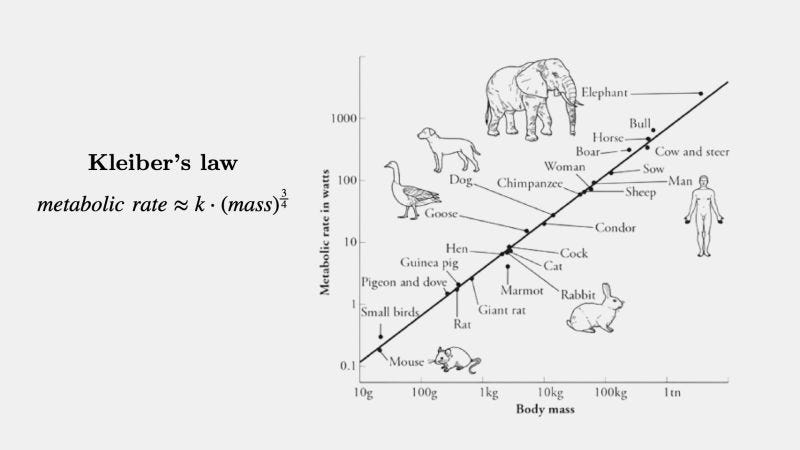
West saw that this wasn’t biological accident. It was a consequence of network geometry, the way capillaries and bronchioles and neural pathways branch. The math of networks imposes the math of survival. He spent years wondering whether that logic applied anywhere else.
It did.
West and his colleagues at the Santa Fe Institute analyzed data on more than 30,000 publicly traded U.S. companies from 1950 to 2009, across dozens of industry sectors. They were looking for scaling laws, the same kind that governed organisms and cities. They found them, and the finding was not reassuring.
Cities scale superlinearly. Double the size of a city and you get roughly a 15% systematic increase in wages, patents, research institutions, and economic output, while infrastructure needs actually shrink proportionally. The scaling exponent is approximately 1.15. The bigger the city, the more productive each person in it becomes. Cities are organisms that grow more innovative with age and size. They accommodate contradiction, eccentricity, the person selling something from a cart next to the person running a hedge fund. Their dimensionality expands as they grow, opening categories of possibility that didn’t exist at smaller scales. It is genuinely difficult to kill a city. Hiroshima recovered. Nagasaki recovered. Detroit is still a city.
Companies scale differently. West’s research on 22,000 companies shows that as they grow from 100 to 1,000,000 employees, net income and assets per person increase at only a 4/5 ratio. The scaling exponent is approximately 0.8. Below 1.0 in the language of scaling laws is sublinear: each unit of growth produces less than a proportional unit of output. Companies grow more efficient in cost, but less productive in innovation. Unlike cities, they cannot keep innovation pace as their internal systems gradually decay, requiring ever more costly maintenance until a single disruption is enough to sink them.
Takeaway: Efficiency and longevity are not the same thing, and in organizations they often trade against each other. The company that has optimized most completely for margin is frequently the most exposed to the next cycle of competition. Growth in size does not mean growth in strength.
The most striking result came from the survival analysis. The mortality of publicly traded companies manifests a roughly constant hazard rate over long periods of observation. Mortality rates are statistically independent of a company’s age. The typical half-life of a publicly traded company, regardless of sector, is about a decade. A company’s probability of dying in any given year is approximately the same whether the company is two years old or twenty. Age offers no protection. Scale offers no protection.
The survival function looks like this:
S(t) = e^(−λt)
You read this as: the probability of a company surviving to time t equals e raised to the power of negative lambda times t, where lambda is approximately 0.1. At ten years, about 37% of companies survive. At twenty years, roughly 14%. By thirty, around 5% of the original cohort remains. Unlike a human mortality curve, which accelerates sharply in old age, this one is relentless from the beginning. Every year costs approximately the same share of remaining survival probability, young or old.
The S&P 500 data tells the same story from a different angle. The average tenure of companies on the index was 61 years in 1958. By the late 1970s it had fallen to around 33 years. By 2020, to roughly 21 years. Current projections put the number somewhere between 12 and 15 years by the end of this decade. That compression is happening in real time, and it is not concentrated in a single sector or a single period of disruption. It is systemic.

Which makes the outliers worth studying carefully. Apple was founded on April 1, 1976, in a garage in Los Altos, California, by Steve Jobs, Steve Wozniak, and Ronald Wayne. It turns 50 this month. By the logic of West’s distribution, a company surviving five decades is a statistical event comparable to a coin landing heads eight or nine times in a row. It happens, but not by accident, and not by the same mechanism that keeps most companies alive long enough to make the news.
What Apple did, repeatedly, was refuse to let its organizational dimensionality compress. Every decade brought a deliberate rupture with the previous identity. The Macintosh was not the Apple II with better margins. The iMac in 1998, when Jobs returned to a company weeks from bankruptcy, was not a cost-optimized version of existing hardware. The iPod in 2001 had no strategic relationship to anything Apple had built before. The iPhone in 2007 didn’t just enter a market, it dismantled several. Each transition required Apple to tolerate, internally, the kind of contradiction and exploratory chaos that West describes as the city’s advantage: new people, new product categories, new cultural identities running in parallel with the old ones. Jobs was famously difficult, but he was also famously protective of the engineers and designers working on things that had no immediate revenue justification. That protection is not a personality quirk. It is the organizational mechanism by which a company keeps its scaling exponent above the sublinear threshold.
Takeaway: A company that has survived thirty years has not beaten the odds. It has survived several independent draws from the same distribution, each with roughly a 10% annual mortality rate. The S&P 500 average tenure, falling from 61 years to a projected 12, is not a story about economic turbulence. It is a story about what scaling does to an organization over time. Apple’s fifty-year survival is not evidence that longevity is achievable through good management in a general sense. It is evidence that one specific behavior, the repeated willingness to generate new dimensional space rather than extract efficiency from existing space, can hold the curve at bay.
West has a one-sentence explanation for why companies die while cities live:
“Cities tolerate crazy people. Companies don’t.”
It sounds like a quip. It is actually a systems observation. Cities accommodate the full spectrum of economic behavior: the experimental, the redundant, the economically marginal, the purely strange. A city doesn’t eliminate the jazz bar because it has a lower return per square foot than a pharmacy. The diversity is the point, and that diversity is what generates the serendipitous collisions between industries, the accidental proximity between people who shouldn’t logically be in the same room, the strange new products that emerge when someone who makes paint talks to someone who makes code.
Companies do the opposite. As they grow, they standardize. They optimize. They eliminate redundancy and reward focus. Fringe projects get killed to fund the core. Eccentric employees leave or are managed out. Successful companies focus on what they do best, casting aside the peripheral people and peripheral projects that don’t fit the mission. That concentration is genuinely useful in the short term. Over a long arc, it cuts off the serendipitous discoveries that fuel cycles of renewal.
Call this Sublinear Senescence: the gradual compression of a company’s organizational range as it scales. The term borrows from cellular biology, where senescence describes the state of cells that have stopped dividing and begun secreting compounds that damage surrounding tissue. In corporate terms, it is the process by which growth itself slowly erodes the diversity that made growth possible. It doesn’t announce itself. It arrives through a hundred individually defensible decisions, each one rational in isolation, collectively fatal in aggregate.
Takeaway: Recognizing sublinear senescence early requires asking a direct operational question: what percentage of this company’s current activity is maintenance of existing systems versus generation of new ones? In a young company, almost everything is generative. In a mature one, maintenance quietly becomes the majority without anyone deciding that it should. By the time the ratio is obvious, the compounding has already run for years.
Nike’s story from 2020 onward is a remarkably clean illustration.
Under CEO John Donahoe, Nike made a significant pivot away from wholesale, concentrating instead on direct-to-consumer channels and a suite of digital apps. The financial logic was coherent: wholesale margins run 30 to 35% after retailer markups, while direct sales can approach 50%. Better margins, more customer data, more control over the brand experience. These are the kinds of decisions that look excellent in a board presentation.
But retail shelf space is a zero-sum game. When Nike pulled out, competitors filled the void immediately. And in the product line, the same logic of efficiency played out in parallel. Nike leaned heavily on Dunks, Air Jordan 1s, and Air Force 1s, retro designs with high margins and almost no R&D cost. Legacy silhouettes carry enormous brand equity and cost almost nothing to bring back to market. Reissuing them is the shoe industry’s equivalent of a city tearing down its experimental architecture to build parking lots. More revenue per square foot, until the culture moves on.
It moved on.

On Running’s revenue grew from $330 million in 2020 to $1.8 billion by 2025. Hoka grew from $352 million to $1.4 billion over the same period. These weren’t better-funded competitors. They were smaller companies that filled the dimensional space Nike had vacated. Roger Federer left for On, which he partly owns. Harry Kane signed with Skechers. Simone Biles went to Athleta. Josh Allen moved to New Balance. Tiger Woods left to build his own brand. Athlete partnerships aren’t purely marketing expenses, they are product development inputs. When Michael Jordan worked with Nike in the 1980s, the collaboration produced the Air Jordan line, which was generating over $5 billion in annual revenue by 2023. Cutting those relationships in the name of margin management was, biologically speaking, a company eating its own connective tissue.
Full year revenues fell to $46.3 billion in fiscal 2025, down 10% from the prior year, following two consecutive years above $51 billion. Net income fell more than 40% year over year. The stock, which lost 21% in a single day in June 2024, ended the year down roughly 30%.
Takeaway: Nike’s decline is not a Nike story. It is a scaling story wearing Nike’s shoes. The DTC pivot, the retro SKU dependence, the wholesale vacuum: these are the specific mechanism. The underlying dynamic is the one West’s research describes, a company systematically reducing its own dimensionality in pursuit of efficiency, until the competitors who absorbed that dimensionality are large enough to be visible on a quarterly earnings slide. By then, the compounding has run for years.
None of this was fated the way a Greek tragedy is fated. Specific people made specific decisions in specific rooms. But the shape of the decline follows the biological contour West’s research would have predicted, if anyone inside Nike had been tracking the scaling curve rather than the quarterly comp.
In September 2024, Nike replaced Donahoe with Elliott Hill, a 30-year company veteran. There are early signs of stabilization. West himself doesn’t say all companies must die on a fixed schedule. He says the probability distribution is what it is, and surviving it requires doing what cities do: maintaining dimensionality, tolerating the outliers, funding the peripheral ideas that don’t fit the current roadmap.
Which brings the question back to Apple. Fifty years old, three trillion dollars in market capitalization, the most profitable consumer company in history. And yet the last five years have seen something that looks, through West’s lens, slightly familiar. The Vision Pro arrived to muted commercial reception and quiet retreat. The iPhone, which redefined the company in 2007, has been in gentle revenue plateau. The growth engine now is Services, the App Store, iCloud, Apple Music, Apple TV+, licensing fees from Google. That is a business extracting value from an existing platform rather than opening new dimensional space. It is efficient, high-margin, and strategically coherent. It is also, in the language of cellular biology, a company that has begun to look more like maintenance than generation.
Apple may yet do what it has done before: absorb a period of apparent consolidation and then rupture into something new. The history suggests that’s possible. The physics suggests the window for that rupture is not unlimited. West’s survival curve doesn’t stop running because a company has survived fifty years. It has never stopped running.
The math doesn’t negotiate with legacy. It never has.
STRATEX by Naz publishes at the intersection of cognitive science, behavioral research, business systems, and the ideas that most strategy writing leaves out. If this kind of analysis belongs in your reading life, subscribe below.